

Environmental and Climate Policy
Policy Purpose
At Franklin Display Group, we recognize and acknowledge the importance of environmental conservation and the protection of our environment. FDG is committed to continual improvement of environmental performance. The purpose of FDG's Environmental and Climate Policy is to establish the direction for the company's environmental and climate strategy.
FDG shall:
- Operate in compliance with the laws and regulations that govern our environmental practices
- Consider environmental issues in making business strategies
- Commit to reducing our environmental impact through initiatives that reduce greenhouse gas emissions, water usage, and raw materials
- Train employees on environmental considerations
- Identify and implement projects that improve energy efficiency
The environmental and climate policy shall be reviewed at least once every three years.
EcoVadis Bronze Medal Recipient
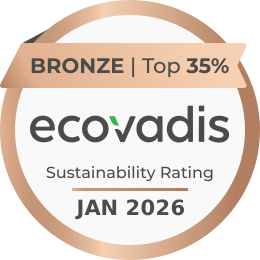
As part of our commitment to Environmental, Social, Governance (ESG), Franklin Display Group completes a thorough assessment of its business sustainability practices every year through EcoVadis, a global leader in business sustainability assessments. The EcoVadis assessment includes 21 sustainability criteria across four core themes: Environment, Labor & Human Rights, Ethics and Sustainable Procurement.
In our latest rating, which was completed in January 2026, we earned a Bronze Medal, which places Franklin Display Group in the top 35% globally.

Environmental and Climate Policy
With the support of the FDG executive management, the ESG Team is responsible for setting environmental and climate commitments.
Franklin Display Group's climate goal is to reduce its absolute Scope 1 and Scope 2 emissions by 25% by 2030 from a 2023 baseline. Our approach is to measure our carbon emissions in accordance with the Greenhouse Gas Protocols (GHGP) and to set near-term greenhouse gas (GHG) reduction targets.
Note: The climate target is applicable for market-based electricity emissions.
We are committed to making continuous progress to reduce our carbon footprint at Franklin Display Group. As part of that process, Franklin Display Group will further define its carbon emissions reduction strategies and implement pollution mitigations. Reducing our carbon emissions will improve the quality of life for our community and employees and reduce the impact of global warming.
Waste and Recycling Policy
FDG's goal is to minimize waste by the following hierarchy: prevention, reuse, recycling, and landfill. Materials commonly recycled at FDG include metal, cardboard, paper, plastic, and pallets.
United Nations Sustainable Development Goals Report
The United Nations Sustainable Development Goals (UN SDGs) provide a shared blueprint for peace and prosperity for people and the planet, now and into the future. At Franklin Display Group, we have prioritized a set of SDGs that are applicable and relevant to our organization. The following provides our list of prioritized Sustainable Development Goals, an assessment of why the goal is important to FDG, FDG’s Target, Actions Taken, and our Results.
Environmental Impact

7 Affordable and Clean Energy
SDG Priority Rationale
- FDG’s emissions from electricity represent 46% of its total emissions (includes Scope 1&2) from a 2023 baseline.
Target
- FDG’s goal is to source 100% renewable energy supply by 2025 for all locations.
Actions Taken
- FDG began receiving 100% Green Power in one location in 2023.
Results (2025)
- 45% renewable electricity.

12 Responsible Consumption and Production
SDG Priority Rationale
- FDG strives to manufacture products in a responsible manner by reducing its impact on the environment. FDG focuses on effective waste management and energy efficiency.
Target
- Reduce use of single-use plastic by 25% by 2027, from a 2023 baseline.
- Develop an approach to measure waste.
- Implement multiple energy efficiency projects.
Actions Taken
- Identified and measured a baseline of single-use plastic.
- Collaborate with waste hauler to obtain waste data for 2026.
- Energy Efficiency projects included LED Lighting and air compressor leak repair.
Results (2025)
- 2025 single-use plastic was 31,489 lbs, a reduction of 36% from a 2023 baseline of 49,405 lbs of plastic. This was achieved through a change from virgin plastic to PCR recycled plastic packaging and reduction in overall plastic consumption.
- Data to be reported by the end of year.
- Completed annually.

13 Climate Action
SDG Priority Rationale
- FDG is committed to continual improvement of environmental performance and reduction of Greenhouse Gases (GHGs).
Target
- FDG’s goal is to reduce 25% of Scope 1 & 2 Emissions by 2030 from a 2023 baseline, toward a long-term goal of net zero.
Actions Taken
- Implement energy efficiency projects, source renewable electricity and reduce reliance on fossil fuels.
Results (2025)
- 30% reduction from the 2023 baseline has been achieved.

15 Life on Land
SDG Priority Rationale
- FDG is committed to increasing biodiversity and preventing biodiversity loss.
Target
- Volunteer 40 hours to support local conservation projects within or adjacent to Boone County, IL.
- Plant and maintain a pollinator garden on FDG property.
Actions Taken
- Initiated discussions with Boone County Conservation District to coordinate volunteer opportunities for 2026.
- Developed a plan to start an on-site pollinator garden.
Results (2025)
- Will be reported upon completion of 2026.
- Will share progress upon completion of progress in 2026.
Social Impact

5 Gender Equality
SDG Priority Rationale
- FDG seeks to commit to gender equality in the manufacturing industry.
Target
- Provide equal pay to men and women who serve in comparable roles, resulting in gender wage parity of 100%.
Actions Taken
- Conduct analysis and adjustment of wages for men and women.
Results (2025)
- 100% gender wage parity.

8 Decent Work and Economic Growth
SDG Priority Rationale
- FDG is committed to maintaining safe and healthy working conditions for its employees.
Target
- FDG’s over-arching goal is to achieve zero harm for its employees.
- The target OSHA Recordable Incidence Rate for FDG is to be less than the average of 4.0 for NAICS 332999 All Other Miscellaneous Fabricated Metal Product Manufacturing.
- Commit to making progress toward all full-time employees making a minimum of the living wage.
Actions Taken
- Conducted monthly safety training for employees.
- Publicly tracked safety incidents to ensure high visibility for all employees.
- Conducted Initial Living Wage Analysis in 2025.
Results (2025)
- 2025 Recordable Incidence Rate = 3.1
- 17 Employee Training Sessions Completed
- 2025 Living Wages Progress is -6%